Level Up Your Learning: How Gamification is Changing Education
Forget rote memorization. Gamification is turning dull lessons into engaging quests, using points and challenges to boost student motivation and make learning stick. It's truly transforming education.
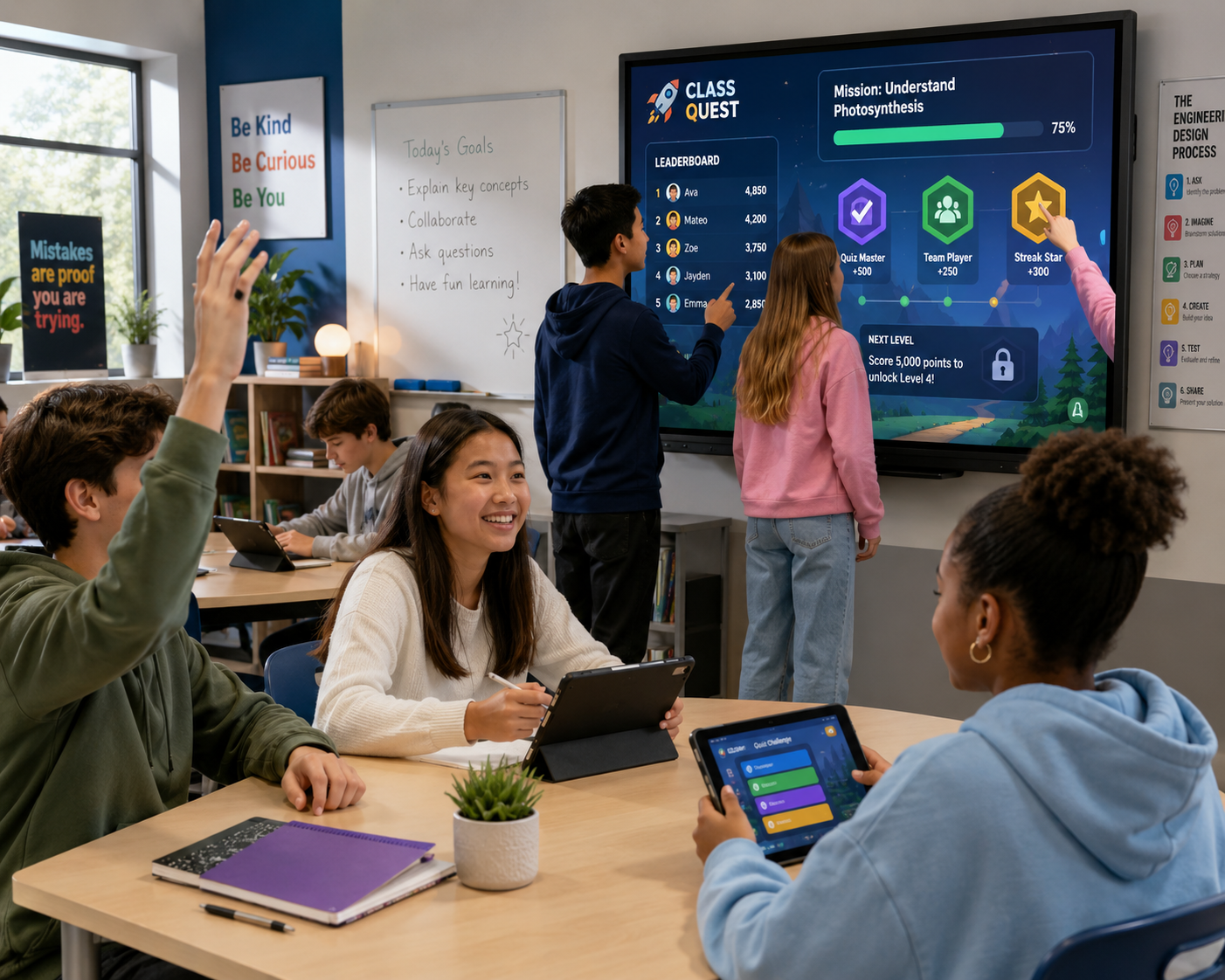
Picture this: a Saturday afternoon, and your teenager is utterly engrossed. Not in a textbook, mind you, but in a sprawling digital world, meticulously completing quests, earning experience points, and leveling up their character. They’re solving complex puzzles, strategizing with teammates, and mastering intricate skill trees, all with an intensity rarely seen during algebra homework. What if that same fierce drive, that thirst for achievement and progression, could be channeled directly into their academic life? That’s the core promise of gamification in learning, a concept quickly shifting from niche experiment to mainstream methodology across classrooms and corporate training programs.
It’s not just about turning education into a cartoonish video game. Far from it. Gamification is the thoughtful application of game design elements and game principles in non-game contexts. We’re talking points for participation, badges for mastering a concept, leaderboards to foster friendly competition, and progress bars that visualize how far you’ve come and how much more there is to learn. The idea isn't new, really. Think about those gold stars on your first-grade spelling tests, or the belts in martial arts. But with digital tools, the possibilities have exploded.
Key Takeaways:
- Gamification uses game elements like points, badges, and levels to boost engagement in learning.
- It taps into innate human desires for achievement, competition, and mastery, making subjects more appealing.
- Effective gamification isn't just about superficial rewards; it fosters deeper cognitive engagement and skill development.
- While powerful, it requires thoughtful design to avoid superficiality and ensure genuine learning outcomes.
- Its application is growing rapidly, from K-12 classrooms to university courses and corporate training modules.
At its heart, gamification works because it taps into fundamental human psychology. We’re wired for challenge, for feedback, for a sense of progression. “Humans are naturally goal-oriented, and games provide clear, immediate goals and rewards,” explains Dr. Anya Sharma, a cognitive psychologist specializing in educational technology at Stanford University. “When you get points for a correct answer, or unlock a new module after completing a series of tasks, your brain releases dopamine. That’s a powerful motivator. It creates a positive feedback loop that encourages persistence.” It’s that feeling of 'just one more level,' but applied to mastering calculus or learning a new language.
Consider the impact on engagement. Traditional learning can often feel passive, a one-way street of information delivery. Gamified systems, however, demand active participation. Students aren't just memorizing dates; they might be participating in a historical simulation, making choices that impact outcomes and earning 'influence points' for well-reasoned decisions. They aren't just solving equations; they're on a 'math quest' where each correct answer brings them closer to unlocking the next challenge or a special avatar upgrade. This transforms abstract concepts into tangible achievements. And it makes learning feel less like a chore and more like an adventure.
One compelling example comes from Classcraft, a platform widely adopted in K-12 schools. Teachers create a virtual world where students are heroes with unique powers, working together in teams. A student might use their 'healing power' to give a classmate extra time on an assignment, or their 'teleportation power' to get permission to move seats. Positive behaviors like turning in homework on time or helping peers earn experience points, while negative ones might result in 'damage' to their character. “My students used to drag their feet on group projects,” says Sarah Jenkins, a middle school science teacher in Portland, Oregon. “Now, with Classcraft, they’re strategizing like a professional esports team, because their characters’ success depends on their collaboration. Attendance is up, and they’re even doing extra research to get an edge.” It’s a remarkable shift, proving that motivating students to learn can be more intuitive than we often think.
The applications aren’t confined to early education, either. Universities are experimenting. At the University of Michigan, a gamified online course for computer science saw significant improvements in completion rates and student satisfaction compared to traditional formats. Students earned badges for completing coding challenges, collaborated on 'guild' projects, and competed on leaderboards for extra credit. This isn't about trivializing complex subjects; it's about providing a framework that makes the pursuit of knowledge more compelling. It speaks to a broader trend where technology is reshaping learning environments in profound ways.
Beyond formal education, corporate training is another fertile ground for gamification. Companies are using gamified modules to train new hires, teach compliance, or upskill existing employees. Instead of dry webinars, employees might navigate a virtual office scenario, earning 'compliance credits' for identifying risks or 'leadership badges' for successfully resolving simulated conflicts. The result? Higher engagement, better retention of information, and a more positive attitude toward continuous learning. According to a recent report by TalentLMS, 89% of employees felt that a gamified system made them more productive and happier at work. It shows that even in professional settings, the human desire for achievement and recognition remains potent.
But it’s not all sunshine and high scores. Critics rightly point out that poorly designed gamification can fall flat or even backfire. If the rewards are purely extrinsic – just points for points' sake – it can undermine intrinsic motivation, teaching students to chase arbitrary goals rather than genuinely engage with the material. “The trick isn’t just adding points and badges,” warns Dr. Sharma. “It’s about designing systems that encourage deep cognitive engagement, problem-solving, and collaboration. The game elements should enhance the learning, not distract from it or become the sole focus.” If the 'game' feels shallow or disconnected from the core subject, students will see right through it.
Another challenge is ensuring equity. Not all students have equal access to devices or stable internet connections, which can create disparities in purely digital gamified experiences. And for some learners, constant competition can be demotivating rather than inspiring. Thoughtful implementation means offering diverse pathways to success, not just leaderboards, and providing support for those who struggle. It's about designing inclusive experiences that truly enhance everyone's education and skills.
Yet, the potential for well-designed gamification is immense. It offers personalized learning paths, allowing students to progress at their own pace and focus on areas where they need more practice. It provides immediate feedback, helping learners correct mistakes in real-time. And it fosters a sense of agency, letting students feel more in control of their learning journey. This isn’t just about making learning 'fun'; it's about making it effective and enduring. The future of work, with its constant need for reskilling and upskilling, will demand more engaging and effective learning paradigms, making gamification a crucial tool in our collective educational arsenal. It's a key part of how we’re preparing for the future of work.
Frequently Asked Questions:
-
What exactly is gamification in learning? It’s applying game design principles and elements, such as points, levels, badges, and challenges, to educational contexts. The goal is to boost engagement, motivation, and the retention of learned material by making the process more interactive and rewarding.
-
Does gamification only work for younger students? Not at all. While highly effective in K-12, gamification is increasingly used in higher education and corporate training. Adults respond just as positively to clear goals, feedback, and a sense of progression when learning new skills or compliance.
-
Can gamification be harmful to learning? Poorly implemented gamification can be counterproductive if it focuses too much on superficial rewards or creates excessive competition. However, when designed thoughtfully to align with learning objectives and foster intrinsic motivation, it significantly enhances the educational experience.
-
How is technology improving gamification in education? Technology allows for dynamic, personalized, and interactive gamified experiences that wouldn’t be possible otherwise. Apps and platforms can track progress, offer immediate feedback, adapt to individual learning styles, and connect learners in collaborative environments, making gamification more scalable and sophisticated.
As we look ahead, the integration of artificial intelligence will likely usher in even more sophisticated gamified learning experiences, adapting dynamically to individual learners, offering personalized challenges, and even generating unique narrative quests. It won’t replace the essential role of thoughtful educators, but it will certainly equip them with powerful new tools. The classroom of tomorrow might just feel a lot more like an adventure, and that’s a win for everyone.